
Service Dog Training Asheville NC
Whether you need a therapy dog for visiting hospitals, an emotional support animal for daily comfort, or a task-trained service dog for psychiatric or mobility support, our specialized programs prepare you and your dog for the important work ahead.
 Call (828) 338-8255
Understanding Service Dog Categories & Your Options
The world of service dogs, therapy dogs, and emotional support animals can be confusing. Different types of assistance dogs have different purposes, different legal protections, and require different levels of training. Before we dive into our programs, let's clarify what each category means so you can determine which path is right for you and your dog.
Therapy Dogs
Therapy dogs visit hospitals, nursing homes, schools, and other facilities to provide comfort to people other than their handlers. They must be exceptionally friendly, calm, and well-behaved in all environments. Therapy dogs do not have public access rights—they visit facilities by invitation only. They require handler-administered evaluation and often organization membership.
Emotional Support Animals (ESAs)
ESAs provide comfort and emotional support to individuals with mental health conditions simply through their presence. They don't require specific task training and don't have public access rights. However, they do have housing protections under the Fair Housing Act. An ESA designation requires a letter from a licensed mental health professional.
Psychiatric Service Dogs
These are fully-fledged service dogs trained to perform specific tasks that mitigate a psychiatric disability such as PTSD, severe anxiety, or depression. Unlike ESAs, they ARE trained to do work or perform tasks. They have full public access rights under the ADA. Examples include alerting to anxiety attacks, providing deep pressure therapy, or interrupting harmful behaviors.
Mobility Service Dogs
Service dogs trained to assist with physical disabilities. Tasks might include retrieving dropped items, opening doors, providing balance support, or pressing buttons. These dogs require extensive training and must be completely reliable in public settings. They have full ADA public access rights.
📋 Important Legal Distinctions
Under the Americans with Disabilities Act (ADA), only dogs trained to perform specific tasks for a person with a disability qualify as "service animals" with public access rights. Emotional support animals, while valuable, are NOT service animals under the ADA and do not have the same access rights. Therapy dogs visit facilities by arrangement, not by right. Understanding these distinctions helps you set appropriate expectations and avoid legal complications.
Our Asheville Service Dog Training Programs
We offer three specialized programs to meet different needs. Whether you want your dog to become a certified therapy dog, need a well-behaved emotional support animal, or require a task-trained service dog, we have the expertise to help you achieve your goals.
Therapy Dog Development or ESA
- Prepare for therapy dog testing & certification
- OR train as well-behaved Emotional Support Animal
- 8 comprehensive lessons with certified trainer
- Testing preparation for your CGC (Canine Good Citizen)
- Calm behavior in all environments
- Appropriate interaction with strangers
- Includes e-collar and leash
Psychiatric/PTSD Response Service Dog
- For anxiety attacks, night terrors, PTSD symptoms
- Course includes Basic Obedience foundation
- Testing for your CGC certification
- Deep pressure therapy training
- Alert and interrupt behaviors
- Light switches and door commands
- Security and comfort tasks
Mobility Support Service Training
- For medical need service dog candidates
- 8 weekly lessons with certified trainer
- Extended distance obedience (50+ yards)
- Choice of 4 specialized commands
- Heel, Watch, Through, Stand, Front, Touch, Directional Sends
- Includes e-collar and leash
- 30-45 min daily practice required
⚠️ Important Requirements
For Psychiatric Service Dog and Mobility Support programs: Your dog must be the perfect candidate. Not every dog has the temperament, drive, and stability required for service work. We require an evaluation before accepting dogs into these programs. Additionally, handlers must be prepared to commit to significant daily practice—at least 30-45 minutes—and schedule lessons one week apart to allow for proper skill development between sessions.
Psychiatric Service Dog Task Training
For individuals struggling with anxiety disorders, PTSD, depression, or other psychiatric conditions, a properly trained psychiatric service dog can be life-changing. Unlike emotional support animals that provide comfort through presence alone, psychiatric service dogs are trained to perform specific tasks that directly mitigate symptoms of the handler's disability.
Do you have anxiety attacks that make daily tasks difficult? Not know when they're going to occur? Perhaps you have night terrors that make it impossible for you to get a good night's sleep? These are exactly the situations where a psychiatric service dog can help.
Tasks We Train For Psychiatric Support
🔬 The Science of Deep Pressure Therapy
Deep pressure therapy (DPT) is one of the most common tasks for psychiatric service dogs. When a dog applies firm, consistent pressure to a handler's body—typically by lying across their lap or chest—it activates the parasympathetic nervous system. This triggers a calming response similar to being hugged, reducing heart rate, lowering cortisol levels, and helping interrupt the fight-or-flight response that characterizes panic attacks and PTSD episodes.
The training methodology for these tasks draws on operant conditioning principles outlined in texts like "How Dogs Learn" by Burch & Bailey and Steven R. Lindsay's comprehensive work on applied canine behavior.
What Our Program Includes
Our Psychiatric/PTSD Response Service Dog program is comprehensive, spanning 8-12 weeks depending on your dog's progress and your specific needs. Here's what's included:
Foundation Training
- Complete Basic Obedience curriculum
- Reliable responses in all environments
- Distraction proofing for public access
- Calm behavior in novel situations
- CGC (Canine Good Citizen) test preparation
Specialized Task Training
- Deep pressure therapy on cue and by alert
- Light switch and door manipulation
- Anxiety alert and interrupt behaviors
- Customized tasks for your specific needs
- Public access behavior refinement
Therapy Dog & ESA Program Details
Is your goal to have your dog become a therapy dog, visiting hospitals and bringing joy to patients? Or perhaps you just want a well-behaved family member who can serve as your Emotional Support Animal? Our Therapy Dog Development/ESA program covers both paths.
What Makes a Good Therapy Dog?
Therapy dogs need a very specific temperament. They must be:
Temperament Requirements
- Genuinely enjoys meeting strangers
- Calm and stable in chaotic environments
- Tolerant of awkward handling
- Comfortable with medical equipment
- Not easily startled by sudden sounds
- Reliably friendly with everyone
Training Requirements
- Solid basic obedience commands
- Polite greetings (no jumping)
- Walks calmly on leash without pulling
- Ignores distractions and other animals
- Settles quietly when needed
- Passes CGC and therapy dog evaluations
Not every dog is cut out for therapy work. Some dogs are too nervous, too excitable, or simply don't enjoy interacting with strangers. Part of our program involves honestly assessing whether your dog is a good candidate. If they're not suited for therapy work, we'll help you understand why and discuss alternatives—perhaps they'd be perfect as a personal ESA instead.
The Path to Therapy Dog Certification
Therapy dogs aren't simply declared—they must pass evaluation through a recognized therapy dog organization. Our 8-lesson program prepares you and your dog for this evaluation process:
Step 1: Foundation Obedience — We ensure your dog has rock-solid basic commands: sit, down, stay, come, and heel. These must be reliable in various environments, not just at home.
Step 2: CGC Preparation — The Canine Good Citizen test is often a prerequisite for therapy dog organizations. Our program includes CGC test preparation and often the test itself.
Step 3: Therapy-Specific Skills — Beyond basic obedience, therapy dogs need specific skills: approaching medical equipment calmly, accepting handling from clumsy or uncoordinated individuals, staying calm around wheelchairs, walkers, and other mobility aids.
Step 4: Evaluation Readiness — We prepare you for the therapy dog organization's specific evaluation requirements, which typically include demonstrating behavior around medical equipment, reaction to multiple handlers, and behavior in confined spaces.
💡 About Emotional Support Animals
If you're seeking an ESA designation, the training process is similar but without the therapy dog evaluation component. You'll need a letter from a licensed mental health professional stating that your animal provides emotional support for a diagnosed condition. Our program ensures your ESA is well-behaved enough to not cause issues in housing situations where ESAs are protected under the Fair Housing Act. A well-trained ESA is less likely to face challenges or complaints from landlords.
Understanding the Differences: A Comparison
To help you determine which path is right for you, here's a comparison of the different assistance dog categories:
| Feature | Therapy Dog | ESA | Service Dog |
|---|---|---|---|
| Public Access Rights (ADA) | No | No | Yes ✓ |
| Housing Protection (FHA) | No | Yes ✓ | Yes ✓ |
| Specific Task Training Required | No | No | Yes ✓ |
| Can Visit Hospitals/Schools | Yes (by invitation) | No | Yes ✓ |
| Requires Professional Letter | No | Yes ✓ | Varies |
| Organization Membership Needed | Yes ✓ | No | No |
Service Dog Training Across Asheville Neighborhoods
We proudly serve individuals throughout the greater Asheville area who need assistance dog training. Whether you're preparing a therapy dog, training an ESA, or developing a psychiatric or mobility service dog, our specialized programs are accessible throughout Western North Carolina. Click your neighborhood below to learn more about our services in your area:
Local Training Opportunities
Part of training any assistance dog involves exposing them to real-world environments. The Asheville area provides excellent training opportunities:
Therapy Dog Preparation: Mission Hospital, local nursing homes, and schools throughout Beaverdam, Weaverville, and surrounding areas offer diverse environments for therapy dog exposure once your dog is ready for supervised visits.
Public Access Training: Downtown Asheville's busy sidewalks, the Biltmore Village shopping district near Biltmore Forest, and the Asheville Mall near Arden provide excellent locations for proofing service dog behaviors in public.
Distraction Training: The tourist traffic throughout Asheville, outdoor dining on Lexington Avenue, and busy farmers markets give us plenty of opportunities to proof behaviors around crowds, food, and other dogs.
Frequently Asked Questions About Service Dog Training
Unfortunately, no. Service dog work requires a very specific temperament: stable, confident, calm, and people-oriented. The dog must be able to remain focused on their handler in highly distracting environments, must not react to other animals, and must be completely reliable in public. Some breeds are more commonly suited for service work, but temperament matters more than breed. We evaluate every candidate dog before accepting them into our service dog programs. If your dog isn't suited for service work, we'll be honest with you—forcing an unsuitable dog into service work is unfair to both the dog and the handler.
The key difference is task training and legal protections. A service dog is trained to perform specific tasks that directly mitigate a disability—alerting to seizures, providing deep pressure therapy during panic attacks, guiding a blind person, etc. Service dogs have public access rights under the ADA. An emotional support animal provides comfort through their presence alone; they don't require specific task training. ESAs have housing protections under the Fair Housing Act but do NOT have public access rights. You cannot take an ESA into restaurants, stores, or other public places that don't allow pets.
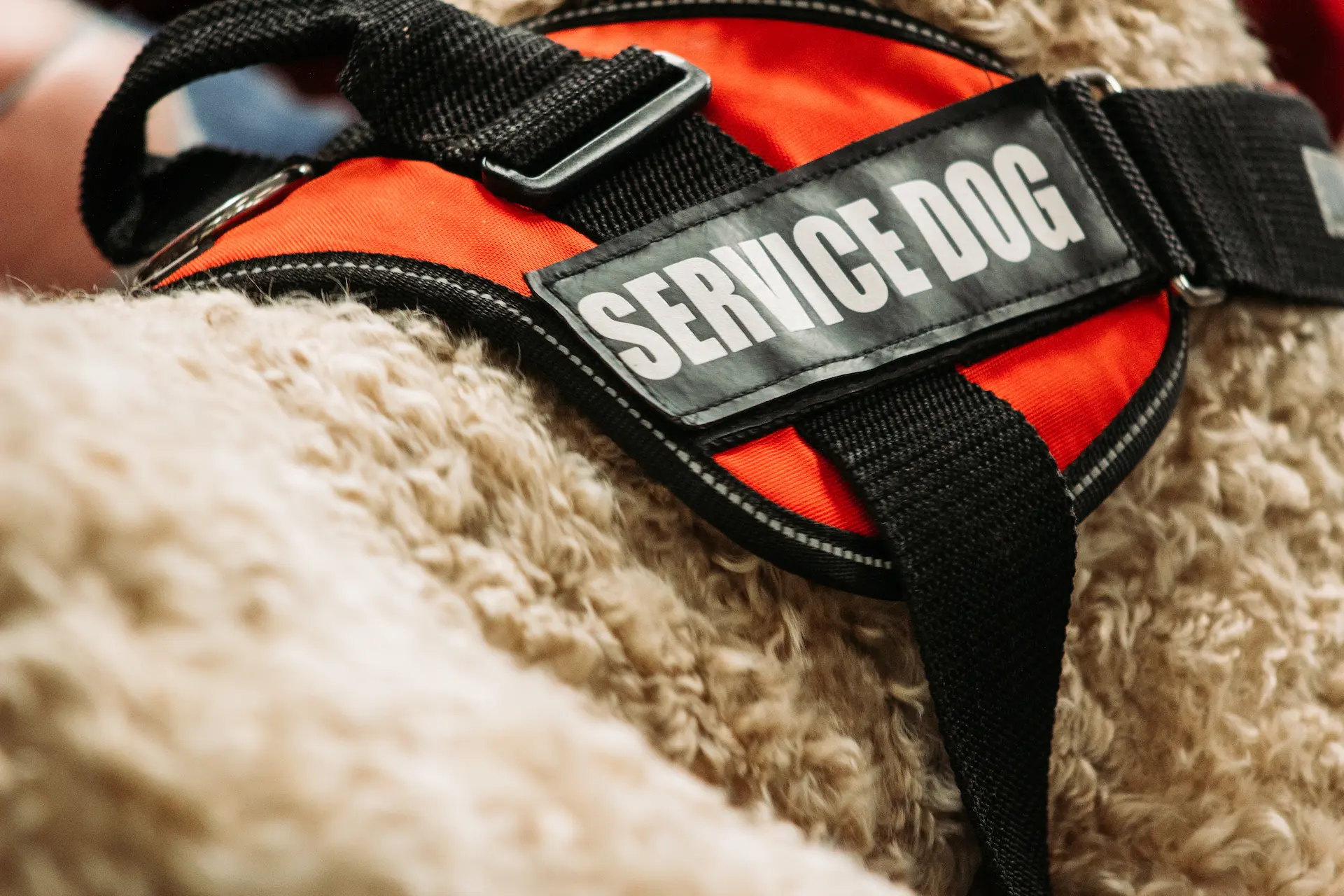
No. There is no legitimate service dog registry in the United States. Websites that claim to "register" or "certify" service dogs for a fee are scams—often illegal scams. Under the ADA, you are not required to have any documentation, ID, or certification for your service dog. Business owners are only allowed to ask two questions: (1) Is this a service animal required because of a disability? and (2) What task has the dog been trained to perform? They cannot require documentation, and your dog doesn't need to wear a vest or ID (though many handlers choose to use these to reduce confrontations).
A fully trained service dog typically requires 1-2 years of training when started as a puppy, or several months to a year for an adult dog with good foundational training. Our programs provide essential task training and public access preparation, but service dog training is an ongoing process. Our Psychiatric/PTSD program runs 8-12 weeks and our Mobility Support program is 8 sessions, but these represent the intensive training phase—maintenance and continued practice are lifelong commitments. The good news is that owner-trained service dogs often develop an exceptionally strong bond with their handlers through this process.
Yes! Under the ADA, you are absolutely allowed to train your own service dog. You don't need to purchase a program-trained dog or hire a professional (though professional guidance significantly increases your chances of success). Our programs are designed specifically to support owner-trainers—we teach YOU to train YOUR dog, rather than training the dog for you and handing them over. This approach builds a stronger handler-dog relationship and ensures you understand how to maintain your dog's training throughout their working life.
While Labrador Retrievers, Golden Retrievers, and German Shepherds are commonly used by professional service dog organizations due to their typically stable temperaments, size, and trainability, any breed can be a service dog if the individual dog has the right temperament. We've seen successful service dogs of many breeds and mixes. What matters is that the dog is confident but not aggressive, calm but not lethargic, trainable and motivated, and comfortable in public environments. A well-tempered mixed breed from a shelter can make an excellent service dog.
Our service dog programs are owner-trainer programs, meaning your dog lives with you throughout training. You attend weekly lessons where we teach you techniques and then you practice at home between sessions. This approach has significant advantages: the dog learns to work with YOU (not transfer handler dependency), you understand exactly how each behavior was trained (making maintenance easier), and the bond between you strengthens throughout the process. For those who need more intensive support, we do offer board and train options for our basic and advanced obedience programs which can provide foundation training before specialized service dog work.
Professional program-trained service dogs typically cost $15,000-$50,000 or more. Owner-training is significantly less expensive but requires more of your time and commitment. Our programs range from $1,000 for therapy dog/ESA preparation to custom pricing for psychiatric and mobility service dog training based on your specific needs. Keep in mind that these prices cover professional guidance and training—you'll also have ongoing costs including veterinary care, food, and equipment. Please call us at (828) 338-8255 to discuss pricing for our service dog programs and get a customized quote based on your needs.
Is Service Dog Training Right For You?
Training a service dog is a significant commitment. Before you begin, honestly assess whether you're prepared for what's involved:
Good Candidates for Owner-Training
Owner-training a service dog works best when:
- You have a dog with excellent temperament
- You can commit to 30-45 minutes daily practice
- You're physically able to handle training tasks
- You can attend weekly training sessions
- You have patience for the long training timeline
- Your disability is stable enough to support training
- You have realistic expectations about outcomes
Consider Alternatives If...
Owner-training might not be the best path if:
- Your disability makes consistent training difficult
- You need a service dog immediately
- Your dog shows signs of being unsuitable
- You don't have time for daily practice
- You're uncomfortable with public attention
- You need tasks we don't train
- Your living situation is unstable
If owner-training isn't right for you, we can discuss alternatives including professionally trained service dogs from reputable organizations. We're committed to helping you find the right solution, even if that solution isn't with us.
📚 Further Reading on Service Dog Training
If you're considering training a service dog, understanding learning theory will greatly help your journey:
"How Dogs Learn" by Mary R. Burch, PhD & Jon S. Bailey, PhD — Essential foundation in operant conditioning
"The Art of Training Your Dog" by The Monks of New Skete & Marc Goldberg — Systematic approach to e-collar training that's relevant for service dog reliability
"Handbook of Applied Dog Behavior and Training" by Steven R. Lindsay — Comprehensive reference for serious trainers
Ready to Begin Your Service Dog Journey?
Whether you need a therapy dog, ESA, or task-trained service dog, we're here to help.
Call (828) 338-8255